
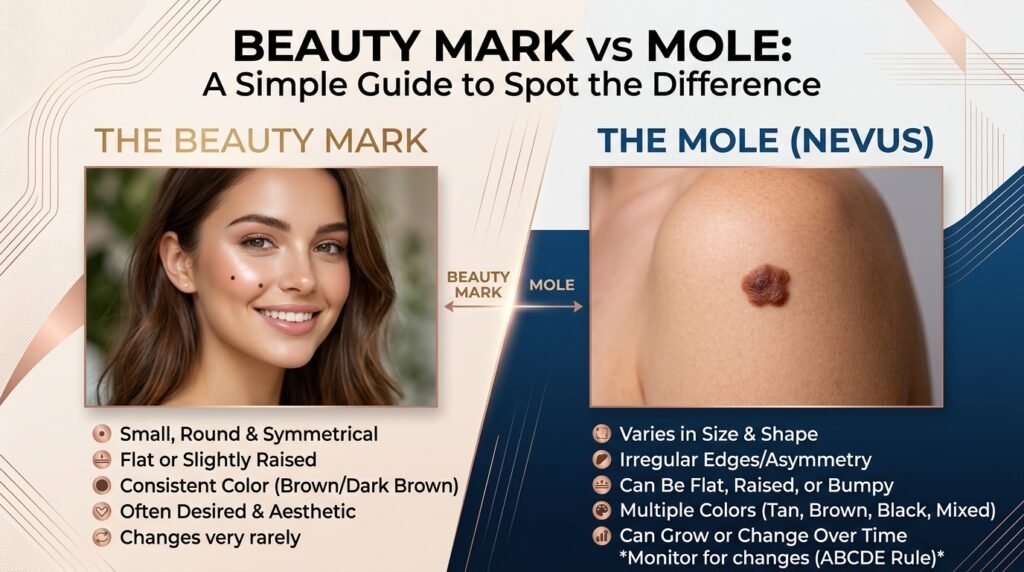
Many people notice small dark marks on their skin. Some call them a beauty mark. Others think they are a mole on skin. This confusion often leads people to search about beauty mark vs mole. Understanding the difference helps you feel calm and informed.
When you learn about beauty mark vs mole, you start noticing details in your skin. A small skin spot might look harmless. Yet sometimes it can be a pigmented mole or another skin pigmentation mark. Knowing the signs helps you understand your skin better.
This guide explains beauty mark vs mole in simple language. You will learn the difference between beauty mark and mole and how to recognise each one safely. By the end, you will understand skin mole vs beauty mark, know common signs, and follow a simple skin mole identification guide to monitor your skin confidently.
Beauty Mark vs Mole: Understanding the Key Differences on Skin
Understanding beauty mark vs mole starts with knowing what each one actually is. Many people use the words interchangeably. Yet dermatology shows they are not exactly the same.
A beauty mark is usually a small, dark skin pigmentation spot. It often appears as a neat dark beauty mark on the face or neck. In fashion history, a beauty spot was even seen as attractive. Some people naturally have natural beauty marks on face, which simply means a tiny cluster of pigment cells close to the surface.
A skin mole, however, forms slightly differently. A skin mole develops when pigment cells gather together deeper in the skin. Dermatologists often call this a dermatology skin mole. These clusters create a brown mole on skin or sometimes a darker pigmented mole. This is why the skin mole appearance can vary more than a typical beauty mark.
When comparing beauty mark vs mole difference, the most obvious clue is structure. A beauty mark normally stays small and flat. A mole may grow slightly or change shape over time. The mole vs beauty mark comparison often focuses on size, texture, and colour.
Another factor is timing. Some spots appear early in life. Others develop later. This leads to confusion between birthmark vs mole vs beauty mark. A birthmark exists at birth. A mole may appear during childhood or adulthood. A beauty mark is usually just a small pigmented spot.
Dermatologists often describe the skin spot vs mole difference using colour and texture. A beauty mark tends to look uniform. A mole may show more variation. This difference becomes clearer when learning about common mole characteristics.
Beauty Mark vs Mole: How to Identify Each One Easily
Many people wonder how to tell beauty mark from mole without visiting a clinic. The truth is that most marks can be recognised by observing small details.
Start with shape. A typical beauty mark is round and symmetrical. The colour remains consistent. It usually looks like a neat skin pigmentation mark on the surface.
A mole on skin, however, can appear in many forms. The mole shape and colour might change slightly over time. Some moles are smooth. Others feel slightly raised. This is where the difference between raised mole vs flat mole becomes important.
A flat mole sits level with the skin. It looks like a small brown spot. A raised mole stands slightly above the skin surface. Some people even notice hair growing from it. Dermatologists consider both forms normal within the types of skin moles.
Another clue appears in the skin mole appearance. A mole may look darker in the centre. The edges might not be perfectly smooth. A dark spot on skin mole sometimes forms when pigment cells gather more densely.
Facial marks also attract attention. Many cultures discuss the facial mole and the mole on face meaning. Historically people believed these marks had personality meanings. However modern dermatology focuses on medical features instead.
Identifying marks correctly requires patience. Experts recommend observing pigmented skin spots carefully under good lighting. If a mark remains stable in size, shape, and colour, it is usually harmless.
Beauty Mark vs Mole: Common Causes and What They Mean
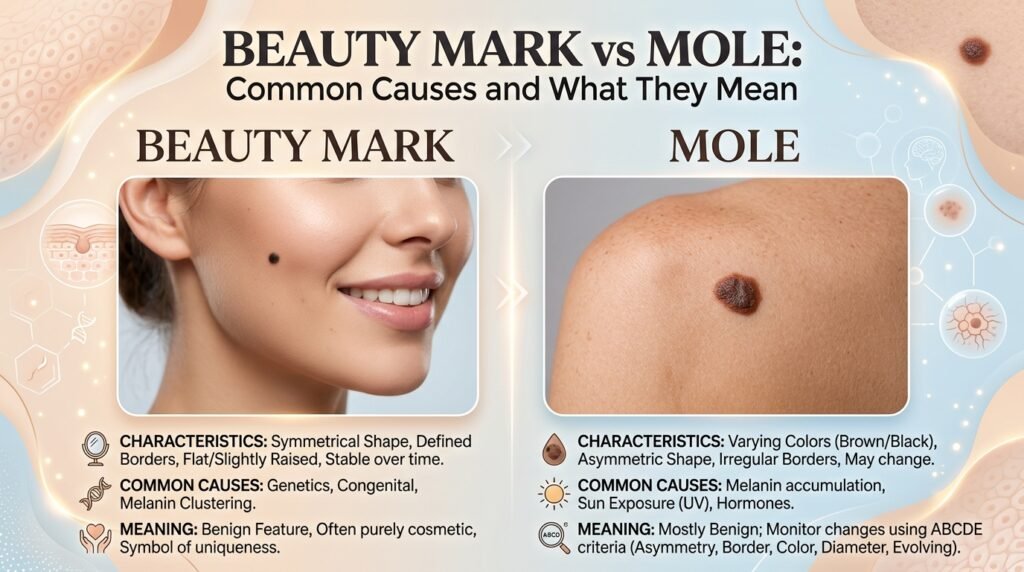
The next step in understanding beauty mark vs mole is knowing why these marks appear.
A beauty mark forms when pigment cells produce extra melanin. This process creates a small skin pigmentation spot. Genetics often plays a role. If parents have beauty marks, children may develop them too.
Sun exposure can also influence pigmentation. UV light stimulates pigment cells. This may cause pigmented skin spots or a dark beauty mark to appear gradually.
Moles develop in a slightly different way. A pigmented mole forms when melanocytes cluster together. These clusters create a skin mole that may remain stable for years.
Dermatologists recognise several types of skin moles. Some stay flat. Others become raised. A common example is the raised mole, which forms deeper in the skin layers. Another type is the flat mole, which appears closer to the surface.
Changes may also occur naturally over time. Hormonal shifts during puberty or pregnancy can influence mole size change. In many cases the mole simply grows slightly larger while remaining harmless.
Skin tone and genetics also affect pigmentation patterns. Some individuals develop multiple skin pigmentation marks across their body. Others only have a few pigmented skin spots.
Understanding these causes helps explain the beauty spot vs mole discussion. A beauty spot is mostly cosmetic. A mole has a slightly more complex biological origin.
Beauty Mark vs Mole: When a Skin Spot Should Be Checked
Most marks discussed in beauty mark vs mole comparisons are harmless. However doctors encourage people to monitor their skin carefully.
Dermatologists often discuss harmless mole vs dangerous mole differences. A harmless skin mole usually keeps the same colour and shape for many years. It stays symmetrical and does not grow quickly.
A suspicious mole, however, may change gradually. The mole shape and colour might become uneven. The border may look irregular. These changes can indicate that the mark deserves attention.
Doctors commonly use the ABCDE rule to evaluate a skin lesion.
| Rule | Meaning |
| A | Asymmetry in shape |
| B | Border irregularity |
| C | Colour variation |
| D | Diameter larger than 6mm |
| E | Evolution or change |
Dermatologists explain this clearly.
Dermatology specialists often say early observation saves lives because skin changes become easier to treat when noticed early.
Another important sign is sudden mole size change. If a spot grows quickly, becomes itchy, or bleeds, medical advice becomes essential.
In many cases the mark turns out harmless. Yet monitoring remains wise. This is why experts recommend following a simple skin mole identification guide every few months.
Skin Mole Identification Guide for Everyday Skin Checks
Monitoring your skin does not require medical training. A simple routine helps you track changes over time.
Look at your skin in natural light. Check areas such as the face, arms, and back where pigmented skin spots often appear. Pay attention to any skin spot that looks different from others.
Many dermatologists encourage taking photographs. Images help track skin mole appearance across months or years. Even subtle mole size change becomes easier to notice.
Sun protection also matters. UV exposure affects pigmentation. Wearing sunscreen helps prevent new skin pigmentation mark development and reduces the risk of abnormal changes.
Regular observation builds awareness. Over time you become familiar with your own skin patterns. This knowledge makes identifying beauty mark vs mole difference much easier.
Beauty Mark vs Mole: Key Differences at a Glance
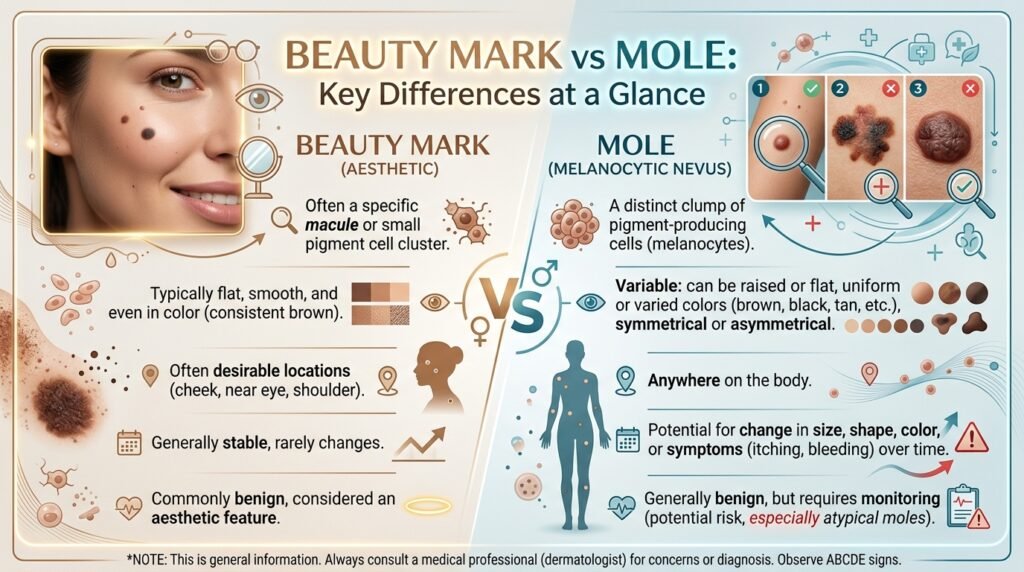
The beauty mark vs mole comparison becomes clearer when you look at the basic characteristics.
| Feature | Beauty Mark | Mole |
| Appearance | Small beauty mark or beauty spot | Larger skin mole |
| Texture | Usually flat | May be raised mole or flat mole |
| Colour | Even dark beauty mark tone | Variable brown mole on skin |
| Formation | Surface pigment | Clustered pigment cells |
| Risk | Mostly cosmetic | Some may become suspicious mole |
Understanding these features simplifies the mole vs beauty mark comparison. It also makes recognising the difference between beauty mark and mole easier for everyday skin care.
FAQs
How can someone know whether a skin spot is harmless
Most cases involve simple observation. Understanding beauty mark vs mole helps recognise stable spots versus marks that show unusual changes.
Why do some people develop more skin marks than others
Genetics and sun exposure influence pigmentation. Many people notice new marks while learning about beauty mark vs mole.
Are small dark spots on the face always moles
Not always. Some are beauty marks or pigmentation spots. Understanding beauty mark vs mole helps distinguish them safely.
Do skin spots change naturally with age
Yes. Hormones and sunlight influence pigmentation. Observing changes while studying beauty mark vs mole helps detect normal ageing patterns.
Should someone worry if a mole becomes raised
Not necessarily. Some raised mole forms are normal. However beauty mark vs mole knowledge helps identify unusual changes.
Can beauty marks appear later in life
Yes. Sun exposure can trigger pigmentation. Many people researching beauty mark vs mole notice new beauty marks gradually.
When should a dermatologist check a skin mark
If colour or shape changes occur. Understanding beauty mark vs mole helps recognise warning signs early.
Conclusion
Understanding beauty mark vs mole helps you read your skin better. Many people confuse these two marks. Yet the beauty mark vs mole difference becomes clearer when you observe shape, colour, and texture carefully.
Most pigmented skin spots remain harmless throughout life. A beauty mark vs mole comparison often shows that beauty marks stay small and stable. A mole may change slightly over time. Learning these patterns reduces unnecessary worry. Still, awareness matters. Watching your skin regularly makes it easier to detect unusual changes. The more you understand beauty mark vs mole, the more confident you feel about your skin health. If something ever seems unusual, a quick dermatology check provides reassurance and early protection.
Find all the beauty in the world through simple daily habits. Learn how small moments, gratitude, and nature can bring real joy.